
Local News
Sapele 2027: INEC’s Constituency Shake Up Ignites High Stakes Power Battle as Umukoro, Pemu, Kogoro, Asagba Fight for Political Supremacy

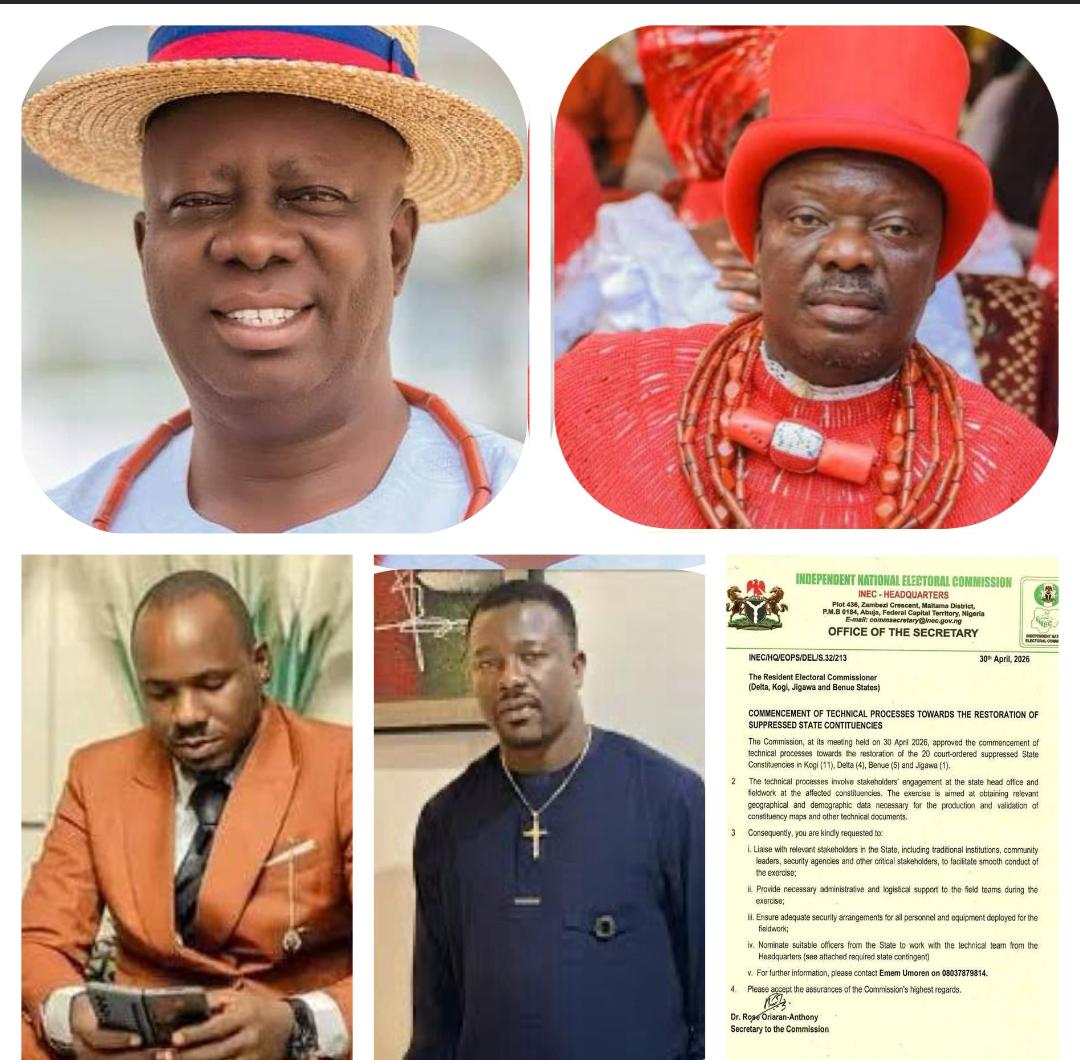
Sapele 2027: INEC’s Constituency Shake Up Ignites High Stakes Power Battle as Umukoro, Pemu, Kogoro, Asagba Fight for Political Supremacy
By Endurance Ikanone
The road to 2027 in Sapele has taken a dramatic and unpredictable turn. What once appeared to be a familiar contest driven by political heavyweights and rising grassroots figures has now been thrown into fresh uncertainty following a decisive move by the Independent National Electoral Commission (INEC).
With the Commission’s announcement of plans to restore previously suppressed state constituencies, the political equation in Sapele is no longer what it used to be. It is now a battlefield being redrawn in real time.
The directive, issued from INEC headquarters in Abuja and dated April 30, 2026, signals the beginning of a technical and administrative process that could fundamentally alter representation across affected states, including Delta State. The Commission outlined a structured plan involving stakeholder engagement, field mapping, and demographic verification all aimed at producing updated constituency boundaries that reflect current realities.
Traditional rulers, community leaders, security agencies, and local stakeholders have been called upon to participate, underscoring the seriousness of the exercise.
But beyond the bureaucratic language lies a powerful political truth: if a new constituency emerges or existing boundaries are altered before the general elections, the Sapele race will be transformed overnight. Long held political calculations may collapse. Alliances may shift. Strongholds may weaken. New opportunities may arise.
At the centre of this unfolding drama are four dominant figures, Perkins Umukoro, Festus Pemu, Melvin Akpomiemie Kogoro, and Hero Asagba, each representing a distinct force within Sapele’s political landscape, and each now forced to recalibrate in the face of a changing terrain.
Perkins Umukoro stands as the most formidable establishment figure. The incumbent lawmaker representing Sapele Constituency in the Delta State House of Assembly and the current Chief Whip, he carries the weight of experience, institutional influence, and political structure. His journey through the ranks of the Peoples Democratic Party (PDP), where he once served as Chairman in Sapele Local Government, laid the foundation for his current standing. Though now aligned with the APC, his roots within the political system remain deep and extensive.
Beyond politics, Umukoro’s identity as a businessman has shaped his administrative style and engagement with governance. His tenure in the Assembly has been marked by legislative participation and constituency level interventions, including empowerment initiatives targeting women and youths, as well as consistent engagement with community stakeholders. To his supporters, he is a symbol of continuity and stability, a man who understands the system and knows how to make it work.
And in a system where influence often matters as much as popularity, many believe that the political machinery especially within the APC may tilt in his favour. The phrase quietly circulating in political circles is simple but telling: the system may favour Perkins Umukoro.
Yet, politics in Sapele is not dictated by structure alone.
Festus Pemu represents the heartbeat of the grassroots. A businessman and community figure with deep local connections, his strength lies not in titles but in relationships. Over time, he has built a reputation as a man of the people, accessible, responsive, and present where it matters most. His political journey, like the others, began within the PDP before transitioning toward the APC, where he is now seen as a key contender.
Pemu’s influence is felt not in legislative chambers but in communities, streets, and local gatherings. His involvement in humanitarian efforts, support for individuals, and participation in community driven initiatives have earned him widespread admiration. He is, by many accounts, massively loved at the grassroots level, a factor that cannot be easily dismissed in any electoral contest.
In a political environment increasingly shaped by voter awareness and demand for direct impact, Pemu’s appeal lies in his ability to connect. He is seen as a bridge between leadership and the people, someone who understands not just policy, but the lived realities of the electorate.
If the race becomes one of public sentiment, he may well be the man to beat.
Melvin Akpomiemie Kogoro emerges as a vibrant and dependable young force whose growing influence reflects a shift toward youth driven leadership.
With his resonating slogan, “Youth O’ Clock,” Kogoro has steadily carved a niche for himself as a grassroots mobiliser with a clear focus on empowerment, inclusion, and social impact.
His recent renovation of the Delta State Youth Center along Awolowo Road in Sapele stands as a visible symbol of his commitment to youth development and community infrastructure.
Beyond this, his interventions have cut across multiple layers of society. He has provided financial assistance to widows, supported small scale businesses, and consistently invested in human capital development.
Kogoro’s youth empowerment initiatives include a 250 slot skill acquisition programme open to residents of Sapele, as well as educational support schemes that have seen 10 students benefit from scholarship opportunities.
His outreach to schools through the distribution of notebooks to primary and secondary school students, alongside the sharing of sanitary pads to female students, reflects a deliberate effort to address both educational and social needs.
His engagement with the informal sector is equally notable, with the distribution of aprons to market women and targeted financial support for entrepreneurs seeking to grow their businesses.
To his supporters, Kogoro represents a new generation of leadership, one that blends compassion with action, and visibility with results.
His growing profile suggests that he may not just be participating in the race, but steadily positioning himself as a serious contender capable of influencing its direction.
Then comes Hero Asagba, the disruptor, the mobiliser, the “king of boys.” His presence in the race injects energy, unpredictability, and a generational shift that is hard to ignore. Known for his strong ties to youth networks and his ability to galvanise support, Asagba represents a new kind of politics, one driven by movement, visibility, and direct engagement.
Though he may not boast a long list of formal political offices, his influence is evident in the enthusiasm that surrounds him. His early declaration and sustained grassroots mobilisation have positioned him as one of the most visible aspirants.
His supporters see him not just as a candidate, but as a movement, a symbol of change and inclusion in a system often dominated by established figures.
His nickname, the “king of boys,” speaks volumes. It reflects loyalty, reach, and the kind of grassroots command that can reshape political outcomes, especially among younger voters eager for representation that reflects their voice.
But now, all four men face a new and unpredictable variable: the possibility of a redefined Sapele.
If INEC’s process leads to the creation of an additional constituency or a restructuring of existing boundaries, the implications will be profound. A split constituency could ease direct competition, allowing more than one major figure to secure political space.
Alternatively, boundary adjustments could fragment existing support bases, forcing candidates to rebuild alliances and rethink strategies.
For Umukoro, it could mean defending a newly carved stronghold or losing parts of his base.
For Pemu, it could present an opportunity to concentrate his grassroots support in a more favourable configuration.
For Kogoro, it could open up new political space for youth driven influence, allowing his growing base to consolidate within emerging demographic zones.
For Asagba, it could expand his reach into new demographics, amplifying his youth driven momentum.
In essence, the race is no longer just about who is strongest, it is about who adapts fastest.
Amid all these shifting dynamics, a deeper question emerges: what does Sapele truly need?
The constituency stands at a critical juncture, requiring leadership that goes beyond politics as usual.
There is a demand for effective legislation, visible development, youth empowerment, and economic growth. There is a desire for representation that is both experienced and responsive, structured yet connected.
Each of the leading aspirants offers a different answer. Umukoro brings experience and institutional access.
Pemu offers grassroots trust and human connection.
Kogoro represents youthful energy backed by tangible community impact.
Asagba embodies energy and a new political culture.
Yet, as the drama unfolds, one appeal continues to echo across Sapele: let the people decide.
In a system often influenced by internal negotiations and elite decisions, the credibility of the 2027 race will depend on whether the will of the people is allowed to prevail. The stakes are no longer just political, they are symbolic of the kind of democracy the constituency seeks to uphold.
With INEC’s constituency restoration process underway, Sapele is no longer preparing for an ordinary election. It is bracing for a political transformation, one that will test ambition, redefine power, and ultimately determine who speaks for the people in a new and possibly reshaped reality.


 Entertainment9 months ago
𝐈 𝐂𝐚𝐧 𝐁𝐞 𝐀 𝐒𝐞𝐜𝐨𝐧𝐝 𝐖𝐢𝐟𝐞’, 𝐓𝐢𝐰𝐚 𝐒𝐚𝐯𝐚𝐠𝐞 𝐎𝐩𝐞𝐧𝐬 𝐔𝐩 𝐨𝐧 𝐌𝐚𝐫𝐫𝐢𝐚𝐠𝐞
- Local News9 months ago
DSS Commended Over Arms Interception in Delta, Urged to Intensify Crackdown on Criminal Networks in Sapele and Environs
- Entertainment9 months ago
‘Not Again, I Can’t Stand the Violence, It’s Too Much’, Regina Daniels Cries Out In Viral Video Over Alleged Beatings By Senator Ned Nwoko
- Entertainment11 months ago
Doyin Kukoyi Clarifies Marriage Rumours with Actor Ogogo: The Story Behind the Viral Photos
- Security10 months ago
How Sapele DPO Turned Police Station into World-Class Facility — Bags Delta Observer News Lifetime Achiever Award of Excellence
- Local News11 months ago
EPL: Roy Keane, Ian Wright predict outcome of Manchester Derby
- Local News9 months ago
Comrades Abebe, Chukwurah Hail Oborevwori’s Visionary Leadership And Development, Commend Flag-Off of ₦21.3bn Ugbolu–Okpanam Road Project
- Local News10 months ago
BREAKING: Jerry Gana Confirms Jonathan’s Return — Ex-President to Join 2027 Presidential Race on PDP Ticket